
The bustling industrial sectors of Sitapura, Vishwakarma (VKI), Sanganer, and Bagru tell a familiar story. Warehouses overflow with hand-carved Sheesham furniture, solid brass artifacts, hand-knotted rugs, and intricate block-printed textiles. The level of craftsmanship and production capacity coming out of Indian manufacturing hubs is world-class.
Yet, when you look at the balance sheets of many manufacturers, the story takes an unsettling turn: soaring top-line turnover, but paper-thin net profit margins.
For decades, traditional manufacturers have relied almost exclusively on B2B wholesaling, third-party exporters, and aggregator platforms like IndiaMART, Meesho, and Myntra. While these avenues once provided dependable volume, the commercial reality has changed drastically. Today, rising raw material costs, unpredictable platform fees, and relentless price wars are squeezing producers to their breaking point.
To survive and thrive over the next decade, forward-thinking manufacturers are making a critical shift: transitioning from anonymous wholesale suppliers into Direct-to-Consumer (D2C) brands powered by independent Shopify storefronts. Businesses can strengthen this transition with professional website design and development services and a well-planned digital strategy.
In this comprehensive guide, we unpack why the traditional wholesale model is hitting a ceiling, the exact financial mechanics of doubling your margins with D2C, and how building an independent digital storefront creates a resilient, multi-million-dollar brand asset for the long run. Effective SEO services and digital marketing solutions can also help D2C brands improve their online visibility and reach potential customers.
The Wholesaler’s Ceiling: Why Relying Only on B2B and Marketplaces Limits Long-Term Growth
Traditional business models provided stability during simpler times, but they carry an invisible structural ceiling that prevents manufacturers from capturing the true value of their work.
The IndiaMART & Aggregator Trap: Competing Exclusively on Price
When you list your products on B2B directories like IndiaMART or sell via open marketplaces like Meesho, the platform architecture inherently commoditizes you. Prospective buyers are placed on a screen where your meticulously hand-hammered brass planter is shown right beside five cheap, machine-stamped alternatives.
In this environment, buyer psychology is conditioned entirely around one question: "Who has the lowest quote?"
There is no room to talk about artisan provenance, material longevity, or the three-generation legacy behind your casting techniques. You are forced to shave your prices down to pennies just to secure the deal. If you raise your prices by even 5%, the buyer simply moves to the next listing.
Thin Margins vs. Rising Raw Material & Labor Costs
Over the past five years, the baseline cost of running a production unit has skyrocketed. Seasoned timber, copper, brass, organic cotton dyes, and skilled artisan wages have climbed steadily.
When you operate on fixed 10%–15% wholesale margins, even a slight fluctuation in logistics or raw material prices completely wipes out your profit. You end up shouldering 100% of the operational risk, while middlemen, retail distributors, and aggregator platforms take the lion's share of the final consumer markup.
Building Someone Else’s Platform Instead of Your Own Long-Term Business Asset
Here is the uncomfortable truth: every order fulfilled through a retail broker or a third-party marketplace is helping them build an asset, not you.
When a customer orders a set of block-printed curtains on Myntra, they do not consider themselves your customer; they are Myntra’s customer. Myntra keeps their contact information, learns their preferences, and uses that data to cross-sell competitors' products tomorrow. You are merely an interchangeable fulfillment node in someone else's supply chain.
Doubling Net Margins: The Immediate Math of Direct-to-Consumer (D2C)
Switching to D2C is not merely a branding exercise; it is an immediate financial upgrade to your bottom line.
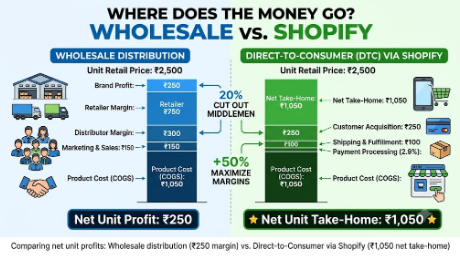
The Breakdown: Where Does the Money Actually Go?
To understand why direct commerce transforms your factory’s balance sheet, look at the cold numbers comparing an identical product under both business models:
1. The Traditional Wholesale Model (High Volume, Vanishing Margins)
- Manufacturing Cost: ?800
- Wholesale Selling Price: ?1,050
- Your Net Margin: ?250 per unit
- Final Retail Shelf Price: ?2,800 to ?3,500
In this setup, your factory absorbs 100% of the production risk, inventory financing, artisan wages, and workshop overhead—yet you walk away with just ?250. The distribution chain (distributors, stockists, and retail showrooms) captures between ?1,750 and ?2,450 of gross margin on the product you manufactured.
If fuel or raw material costs increase by even 10%, your entire ?250 margin is instantly erased.
2. The Direct-to-Consumer (Shopify) Model (Full Margin Capture)
- Manufacturing Cost: ?800
- D2C Retail Selling Price: ?2,600 (more competitive than showroom prices)
- Paid Ads & Courier/Logistics: ?750
- Your Net Take-Home: ?1,050 per unit
By selling directly through your own branded Shopify store:
- You undercut expensive luxury retail showrooms (pricing at ?2,600 instead of ?3,500), offering exceptional value to the end consumer.
- You comfortably absorb performance marketing and pan-India doorstep delivery costs (?750).
- Your take-home profit increases from ?250 to ?1,050—a massive 4.2x increase in pure net cash flow per order.
The Big Takeaway for Manufacturers
To make ?1,05,000 in net profit:
- In the Wholesale Model, you have to produce, pack, and distribute 420 units.
- In the Shopify D2C Model, you only need to sell 100 units.
That means 75% less raw material consumed, 75% less factory labor strain, zero dependency on delayed B2B payment cycles, and you build a direct base of 100 happy customers who will buy again next season at zero customer acquisition cost.
Packaging Authentic Craftsmanship as a Premium Lifestyle Choice
Consumers in metropolitan cities (Mumbai, Bengaluru, Delhi NCR) and affluent international markets do not want nameless, mass-produced decor. They actively seek character, warmth, and authenticity.
When you control your own website, you are not trapped in a rigid grid of identical marketplace cards. You have the canvas to showcase:
- High-definition video showing the metal spinning and hand-etching process.
- The story of the master artisans crafting the piece.
- Styling suggestions demonstrating how the piece transforms a contemporary living room.
Storytelling bridges the gap between a commodity and a luxury lifestyle artifact, allowing you to comfortably command premium retail pricing without pushback.
Turning Single-Item Buyers into High-Average-Order-Value (AOV) Customers
On marketplaces, customers buy one isolated product and leave. On an independent Shopify store, you control the entire merchandising experience.
Using intelligent bundle apps, cross-sells, and tiered discounts (e.g., "Complete the Look: Add Matching Brass Candle Holders for 15% off"), home decor brands routinely elevate their Average Order Value (AOV) from ?1,200 to over ?3,800 per transaction.
Building a Resilient, Long-Term Business Asset (Why D2C Wins Over the Next 10 Years)
A wholesale operation is often valued only on physical machinery and raw warehouse inventory. A direct-to-consumer brand, however, commands a true company enterprise valuation.
Marketplace Storefront vs. Independent Brand: Which One Holds Real Valuation?
If an investor, private equity firm, or buyer looks at your enterprise:
- A business with ?10 Crore in revenue on Meesho/Amazon is viewed as high-risk. Why? Because the platform could alter its ranking algorithm, introduce a private-label clone, or suspend the seller account overnight.
- A business with ?10 Crore in revenue on an independent Shopify store is an enterprise asset. You possess proprietary traffic, direct customer access, repeat brand search volume, and defensible brand equity.
Protecting Your Intellectual Property, Design Exclusivity, and Artisan Heritage
Every manufacturer has experienced this frustration: you spend months developing an original, innovative furniture or textile pattern. Within four weeks of listing it on a marketplace, five competing sellers copy your photos, clone your design using sub-par materials, and undercut your price.
With your own branded storefront, your unique design collections remain protected under your brand umbrella. You dictate the presentation, safeguard your creative work, and build an exclusive customer following that respects genuine design.
Immunity Against Sudden Platform Policy Changes, Account Suspensions, and Fee Hikes
Third-party marketplaces periodically update their fee structures, increase shipping charges, or tighten return windows with zero seller input. Waking up to an algorithm change that cuts your listing visibility by 70% can cripple a factory overnight.
Owning your Shopify infrastructure means you own your digital real estate. Nobody can de-list your best-selling product or throttle your visibility.
Maximizing Customer Lifetime Value (LTV): The True Engine of Long-Term Wealth
The real profitability in e-commerce does not come from the first sale; it comes from the second, third, and fourth purchases where your customer acquisition cost (CAC) drops to zero.
100% First-Party Customer Data: Building Your Permanent Buyer Database
Every order placed on Shopify delivers verified first-party data: customer names, shipping addresses, phone numbers, email addresses, and specific purchasing behaviors.
This data is your company’s greatest digital asset. Over three to five years, a customer database of 50,000 to 100,000 verified decor buyers becomes a perpetual revenue engine that no competitor can touch.
Zero-Cost Festive Remarketing via WhatsApp, SMS, and Email Automations
When festival seasons arrive—Diwali, New Year, wedding seasons—marketplace sellers must bid aggressive sums on sponsored ads just to get their own past customers to look at their products.
With a dedicated store, automated flows do the heavy lifting at negligible cost:
- Automated Abandoned Cart Flows: Recover 15%–25% of uncompleted checkouts via WhatsApp alerts.
- Segmented Festive Broadcasts: Send exclusive catalog previews to your top 20% highest-spending customers.
- Post-Purchase Follow-Ups: Trigger automated care instructions (e.g., "How to care for your solid brass decor") followed by a complementary product suggestion 14 days later.
Creating Loyal Brand Advocates Who Never Ask for Marketplace Discounts
When customers develop an emotional connection to your aesthetic, your packaging, and your unboxing experience, they stop looking for discounts. They become brand loyalists who proudly tag your products on Instagram and recommend your brand by name to friends and family.
Why Shopify is the Ideal Platform for Long-Term Scaling
Shopify powers over 4 million businesses worldwide, including top Indian and global decor brands, because it is engineered specifically for direct commerce.
Visual Storytelling & Immersive Lookbooks Built for Decor and Artisanal Products
Home decor is deeply visual and emotional. Shopify’s ecosystem allows brands to build:
- "Shop the Room" Interactive Features: Let buyers click directly on a styled living room photo to purchase the rug, lamp, and cushion covers together.
- High-Res Zoom & 3D AR Models: Allow buyers to see the exact texture of handloom fabric or preview a brass statue on their console table using augmented reality.
Frictionless Global Expansion: Selling in USD, EUR, and GBP at 3x to 5x Domestic Margins
Handicrafts and Indian home decor command immense value in overseas markets like the United States, United Kingdom, Australia, and the UAE. A wooden carving or hand-block bedspread that sells for ?2,500 in India frequently commands $90 to $140 (?7,500 to ?11,500) abroad.
Through Shopify Markets, international selling is built into the core:
- Automatic local currency display and checkout.
- Calculation of duties and taxes at checkout.
- Multi-language support and international payment gateways (PayPal, Stripe, international credit cards).
Scalable Architecture: Smooth Operations from 10 Orders a Day to 10,000
You never need to worry about server crashes during festive sales spikes. Shopify provides 99.99% uptime, bank-grade security, and seamless connections with major Indian logistics aggregators (Shiprocket, Delhivery, Bluedart) and ERP systems.
Leave a Comment