
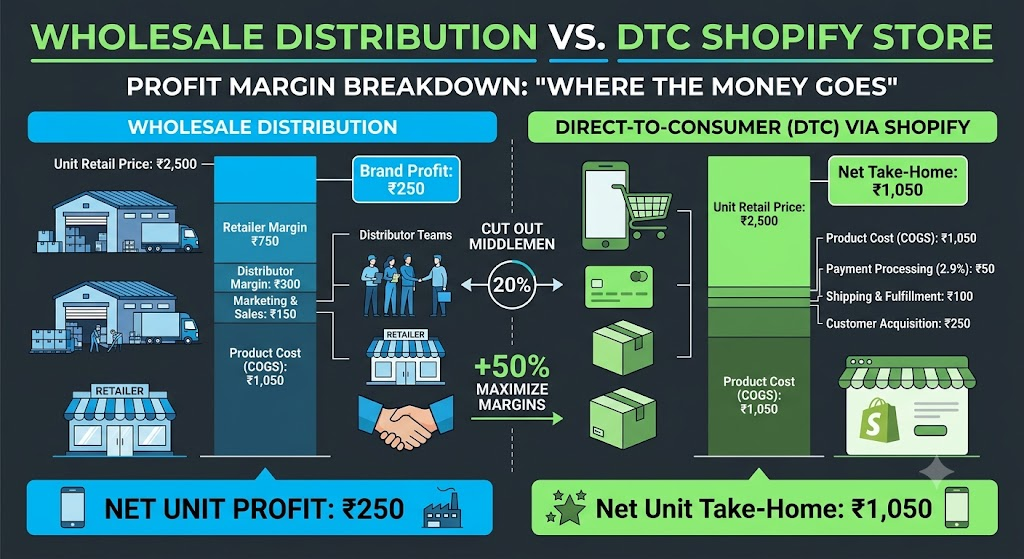
Every morning, thousands of Indian manufacturers, fashion merchants, and lifestyle brand owners open their seller dashboards on platforms like Meesho, Myntra, Flipkart, and Amazon. The graphs look impressive at first glance: hundreds of dispatched parcels, high daily order volumes, and gross sales figures that run into lakhs of rupees.
Yet, when the bi-weekly payout settlement hits their bank account, the celebratory mood evaporates.
After factoring in platform referral cuts, payment handling fees, reverse logistics for customer returns, damaged goods, and platform advertising spends, the net profit is razor-thin. In worse scenarios, sellers find themselves operating at a net loss despite clocking record shipment volumes.
This vicious cycle is known as **The Marketplace Trap**.
While third-party aggregators promise frictionless volume, their algorithmic structures, punitive commission layers, and aggressive discounting mandates drain your business of real cash flow.
If you want to build a business that is genuinely profitable and legally yours for the long term, the solution is not to sell cheaper on someone else's platform. The solution is taking control of your distribution through an **independent Direct-to-Consumer (D2C) Shopify storefront.** Businesses can support this transition with professional website design and development services and strategic SEO services to improve their online presence. Additionally, digital marketing services can help brands reach their target audiences and build awareness for their independent storefronts.
The Illusion of High Sales: Why Big Numbers Aren't Hitting Your Bank Account
Gross merchandise value (GMV) is a vanity metric. What matters at the end of every fiscal month is net cash in bank. Unfortunately, the math of third-party platforms is intentionally structured to disguise where your revenue disappears.
The Hidden Deductions: Referral Fees, Shipping Surcharges, and Reverse Logistics
When you price an item on Myntra or Meesho, you are never just paying a single flat fee. A cascade of micro-deductions chips away at your invoice value:
If even one customer returns that item, the reverse logistics and repackaging costs will wipe out the profit of your next three sales. Sellers are left doing high-stress manual labor for an effective margin that barely covers their office electricity bills.
The Return-to-Origin (RTO) Nightmare: How Unchecked Returns Destroy Thin Margins
Return-to-Origin (RTO) is the single biggest profit killer in Indian e-commerce. On open marketplaces, liberal "no-questions-asked" return windows and zero customer accountability encourage impulsive, non-serious buying.
Customers routinely order three different sizes of the same kurta on Myntra or Meesho, try them on, keep one, and hand two back to the courier. Even worse, on Cash-on-Delivery (COD) orders, consumers frequently reject the parcel at their doorstep simply because they changed their mind or were unavailable.
Who bears the financial brunt of this trial behavior? The seller.
- You pay the forward delivery shipping fee.
- You pay the reverse logistics penalty.
- You absorb transit damages, broken tamper-evident seals, and soiled packaging.
In categories like ethnic apparel, footwear, and home decor, marketplace return rates regularly hover between 25% and 40%. When nearly one out of every three parcels bounces back at your expense, operating profitably on a 15% wholesale margin is mathematically impossible.
To build a more sustainable online business, sellers can invest in a dedicated storefront supported by professional website development services. Improving product-page visibility through SEO services and reaching relevant audiences with digital marketing services can also help independent D2C brands grow their online presence.
The Quality Dilemma: How Ruthless Price Wars Force Sellers to Cut Corners
Beyond immediate cash-flow drainage, marketplaces inflict an even deeper wound: they systematically destroy your product quality and your brand reputation.
Why Marketplace Algorithms Prioritize the Cheapest, Not the Best
Marketplace ranking algorithms are programmed for immediate transaction conversions. They do not care about the thread count of your pure cotton sheets, the grade of your brass hardware, or the environmental safety of your dyes.
The algorithm looks at two primary levers: Conversion Rate and Lowest Price Point.
If a competitor lists an imitation product using synthetic polyester instead of pure handloom cotton and undercuts your price by ?150, the algorithm instantly demotes your listing and promotes theirs. To regain sales velocity, you are forced into an unwinnable "race to the bottom"—slashing your prices, compromising on raw materials, and lowering your production standards just to appear in the search results.
How Competing on Price Slowly Destroys Your Brand Reputation
When you are forced to degrade fabric weight, substitute brass for zinc alloy, or skip quality-control checks, the customer does not blame the marketplace. They blame your product.
Bad reviews pile up, your star ratings drop, and your brand becomes associated with cheap, disposable goods. Once a brand is categorized as "cheap" in the consumer’s mind, you can never command premium prices again. You have traded your long-term reputation for short-term platform survival.
To build a stronger independent brand, businesses can invest in a professional website design strategy that showcases product quality and brand identity. A well-optimized online store supported by search engine optimization can help potential customers discover your products through relevant search queries.
Brands can also use social media marketing services to communicate their craftsmanship, share product stories, and build relationships with their target audience. With the right content marketing strategy, manufacturers can highlight the quality, materials, and value that differentiate their products from cheaper alternatives.
The Direct-to-Consumer Shift: Why Savvy Sellers Are Migrating to Shopify
Direct-to-Consumer (D2C) is not an unproven trend; it is the proven playbook of India's most successful retail brands. Migrating your core catalog to an independent Shopify store fundamentally rewires your business model in three critical ways:
0% Platform Commission: Keeping the Full 20% to 35% in Your Business
Shopify does not operate on a predatory commission model. They provide the software and digital storefront; you keep your earnings.
Outside of standard payment gateway fees (typically around 2% for Razorpay, Cashfree, or Paytm), the full retail price flows straight into your company’s account. That 20% to 35% previously lost to marketplace commissions can now be reinvested directly into:
- Targeted digital advertising that brings customers straight to your brand.
- Premium packaging that creates memorable unboxing experiences.
- Healthy net profit reserves that protect your business during slow seasons.
Full Control Over Return and Replacement Policies
When you own your Shopify store, you set the terms of service—not a third-party platform algorithm.
- You can replace liberal "return for any reason" policies with a fair "Replacement Only for Transit Damages or Size Exchanges" policy.
- You can mandate an unboxing video within 24 hours of delivery to eliminate fraudulent claims.
- You can run OTP-based phone verification on COD checkouts or offer a 5% discount for prepaid orders, slashing your RTO rate from 35% down to under 8%.
Unlocking the Real Goldmine: 100% Ownership of Your Customer Data
When someone buys from you on Meesho or Myntra, you never see their full phone number or direct email address. The customer belongs entirely to the platform.
On Shopify, you own 100% of your first-party customer data. Every name, delivery address, phone number, and purchase preference is securely logged in your database.
This database is a tangible financial asset. Over two years, building a list of 25,000 verified customers means you can launch new collections, announce flash sales, or drive festival purchases with a single broadcast message—without paying a single rupee in marketplace referral fees.
Key Shopify Features Marketplaces Will Never Offer You
A custom Shopify store does not just match the shopping experience of major marketplaces—it gives you specialized enterprise tools that marketplaces intentionally keep for themselves:
Automated Abandoned Cart and Checkout Recovery
Across the e-commerce industry, nearly 70% of shoppers add products to their cart but leave before completing payment. On marketplaces, you have zero recourse when this happens.
On Shopify, intelligent automation immediately triggers:
- An automated WhatsApp alert within 15 minutes: "Hey [Name], you left your favorite handcrafted bedsheet in your cart! Complete your order now and enjoy an extra 5% off."
- Automated recovery email sequences that recover between 15% and 25% of lost checkouts automatically while you sleep.
Seamless WhatsApp & SMS Integrations for Zero-Cost Repeat Orders
In India, commerce moves on WhatsApp. Shopify integrates seamlessly with WhatsApp Business API tools like Wati, Interakt, and Quickirr:
- Send instant order confirmation messages with live tracking links.
- Run automated post-purchase surveys and loyalty point updates.
- Broadcast festive catalog releases directly to customers' WhatsApp chats, producing immediate sales spikes with zero paid ad spend.
Global Selling Ready: Multi-Currency and International Checkout
Selling on Myntra or Meesho restricts you primarily to domestic, price-sensitive shoppers. But handcrafted items, Indian ethnic textiles, and artisanal decor enjoy enormous demand overseas.
Through Shopify Markets, your store is instantly export-ready:
- Automatically detects the visitor’s country and displays prices in USD, GBP, EUR, or AED.
- Calculates international shipping duties and taxes at checkout.
- Integrates with global payment engines like PayPal, Stripe, and international credit cards, allowing you to sell a product for $85 overseas that fetches only ?1,800 domestically.
The Winning Hybrid Playbook: Turn Marketplace Buyers into Direct Store Fans
Escaping the marketplace trap does not mean you must delete your Meesho or Myntra seller accounts tomorrow morning. The smartest brand owners use a Hybrid Funnel Strategy:
Using Marketplaces for Initial Discovery, Not Long-Term Loyalty
Treat marketplaces as paid discovery engines rather than your primary business home.
- List your mass-market, lower-margin introductory products on Meesho or Myntra to capture initial eyeballs.
- Keep your premium, high-margin, signature collections exclusively on your Shopify store.
- Use the sheer volume of marketplaces simply to identify new buyers, with the explicit goal of moving them onto your own platform for every subsequent purchase.
Smart Packaging Inserts and Exclusive First-Order Store Discounts
Every single box leaving your dispatch facility must contain a branded physical touchpoint:
- The Welcome Envelope: An unboxing card printed on textured paper detailing the artisan story behind your workshop.
- The Irresistible Offer: "Thank you for your purchase! Register your product warranty and get ?300 OFF your next purchase by ordering directly from our official website:smacdigital
- The QR Code Bridge: A scannable QR code that opens an automated WhatsApp welcome flow, instantly capturing the buyer's phone number and handing them a direct checkout link.
By turning anonymous marketplace shoppers into registered direct customers, you convert expensive one-off orders into high-lifetime-value brand relationships.
Scale Your D2C Brand with SMAC Digital
Building an independent e-commerce brand requires more than choosing a pre-made theme. It demands thoughtful technical architecture, conversion rate optimization, and seamless backend operational integrations.
That is where SMAC Digital comes in.
From Strategy to Launch: Complete Shopify Store Development
At SMAC Digital, we specialize in helping traditional manufacturers, craft enterprises, and growing retail brands break free from third-party marketplace dependencies:
- Bespoke UI/UX Design: Custom storefronts that look and feel like premium lifestyle brands, built mobile-first for lightning-fast loading speeds on Indian mobile networks.
- Turnkey Tech Integrations: Full setup of domestic payment gateways (Razorpay, Cashfree, UPI), automated shipping aggregators (Shiprocket, Delhivery), and ERP systems.
- Conversion Optimization (CRO): Streamlined 1-step checkouts, dynamic upsells, and trust badges engineered to maximize conversion rates and minimize drop-offs.
- RTO Defense Systems: Setup of automated COD-to-Prepaid conversion flows and address verification tools to keep delivery failure rates to an absolute minimum.
Get a Free E-Commerce Consultation with SMAC Digital
Stop watching your hard-earned margins get swallowed by 30% platform commissions, return fraud, and unfair price cuts. Take ownership of your customers, your pricing, and your future.
???? Ready to launch your high-converting Shopify store? Contact the e-commerce specialists at SMAC Digital today and claim your free D2C growth audit.
Frequently Asked Questions (FAQs)
1. Isn't it cheaper to sell on Meesho because they claim zero percent commission on some categories?
While platforms like Meesho advertise "0% commission" on specific entry-level catalogs, the true cost of selling is hidden in logistical overhead. Return-to-Origin (RTO) charges, reverse shipping penalties, customer dispute fees, and compulsory advertising credits significantly erode seller earnings. Furthermore, you gain zero customer data, leaving you perpetually dependent on platform promotions to generate volume.
2. How much does it cost to build and run an independent Shopify store?
Shopify plans start at an affordable monthly software fee (approx. ?1,999/month), which covers hosting, security, and checkout infrastructure. Your primary investment is a one-time development and configuration fee with an experienced agency like SMAC Digital, which covers custom visual design, catalog structuring, payment gateway integrations, and automated marketing flows.